The Stolen Renaissance: Why the West Misreads Ukrainian Art
- Maria Hammond

- May 15
- 4 min read
This Easter, instead of preparing for Ukrainian traditions, I immersed myself in creating a flawless panettone. No vyshyvanka, no pierogies, no Paska—just the routine of everyday clothes and the absence of my childhood customs. As I moved through the day, I was painfully aware of traditions left behind, their absence amplifying my ever-present grief at what my country could have been if it weren’t for its tortured history and geography.
Panettone’s long fermentation process produced a flawless dough, but on Easter Day, when I cut into it, something inside me deflated in my modern Swiss kitchen. While technically satisfying, the panettone felt emotionally empty, with nothing else prepared to fill that void. As the last mystery of panettone faded, the floodgates of my immigrant grief opened. My Easter became haunted by emptiness, with the shadows of Ukrainian traditions lurking at every turn.
I created this emptiness. Years in the West have shown me civilization at its best: Van Gogh and Monet paintings, authentic crème brûlée, and croissants. I sat in Rubens’s house, admiring its corners, and ate panettone that tasted complex, sophisticated, and free.
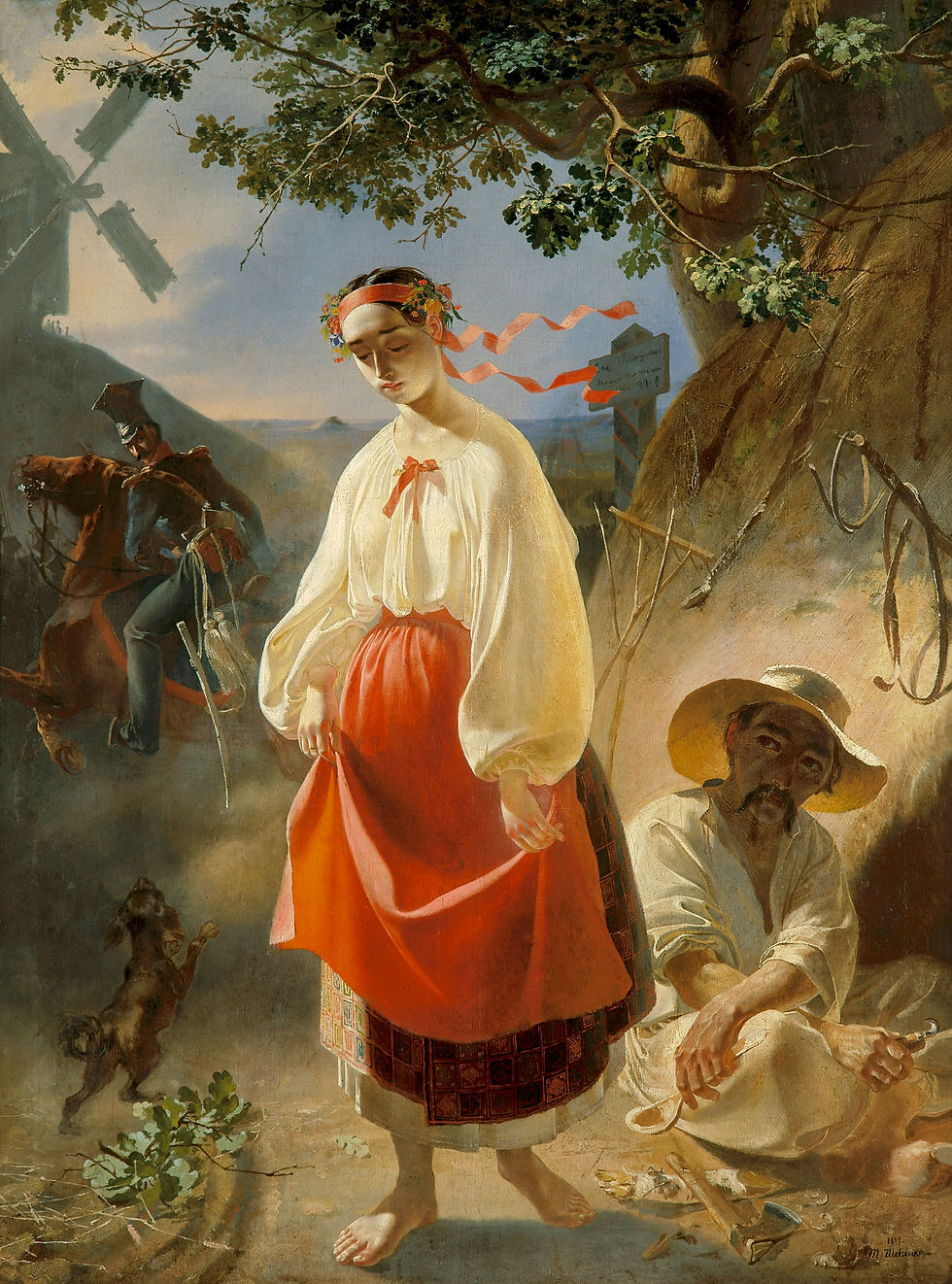
I come from the Lviv region, historically shaped by Central and Western European cultures. Because of Lviv’s cosmopolitan identity, I eagerly absorbed each distinctive culture I encountered across Europe, striving to connect deeply with them. As I embraced these influences, my own Ukrainian culture—rich in its staple foods and unique traditions—began to feel less significant to me. For example, I wondered how a Ukrainian stuffed sloyka, cultivated in Ukrainian house kitchens, could stand alongside a French croissant, carefully curated over hundreds of years in the best bakeries in the world. Similarly, I questioned how Taras Shevchenko’s realism, foundational to Ukrainian art, could be compared to Rembrandt’s globally celebrated works.
At times, I was tempted to scold Ukrainian culture. Why is every 18th-century poem about suffering? It’s bleak. I then realized that blaming Ukraine is as easy as blaming a woman for her suffering—an unhealthy temptation to shift blame from history’s real forces.
It is much more painful for me, and perhaps for all Europeans, to ask why the East, often considered the wild cousin of the West, seems somber and rarely cheerful. How often do we meet a Pole, a Slovak, or a Ukrainian simply enjoying life, unconcerned about whether a bomb may fall on their home, forcing them to grab jars of pickled food and go into hiding?
My grief and Western European integration allowed me to get a momentous bird’s eye view of Ukraine’s history. I now see that it is not Ukraine’s fault that it lacks a Balzac or a Rubens. Ukraine was never allowed to reach its cultural and aesthetic peak.
Ukraine’s history is a series of constant interruptions, power struggles, invasions, wars, and genocides. When Western Europe was undergoing a Renaissance, Ukrainian peasants were still living in servitude, and Ukrainian Cossacks were fighting the emerging Russian empire to live freely on their land. In the 16th-17th centuries, Ukraine was a playground for eight major wars, stretching from east to west across the country. There was simply no moment to stop running from Russia's tiger and take a break, paint, sketch, or think about political philosophy and human rights. When a nation is focused on survival, art and philosophy cannot find the oxygen to breathe.
Whenever a promising Ukrainian was offered some artistic freedom in the Russian Empire, they had to accept the rules of the game: no political statements were allowed in their art, no bright or deep contrasts. Shevchenko was often called the Russian Rembrandt, but unlike Rembrandt, who used deep blacks and bright whites to make a statement, Shevchenko’s colors are careful, as if he were constantly trying not to cross some imperial line. To an artist, that meant his talent could never be properly realised, as his vision was banned. It is almost like putting a cloth over his eyes and tying it up tightly so his hands can paint, but not his soul.
Russia oppressed and banned every single sign of individualism. What it couldn’t contain, it stole, like hundreds of Ukrainian artists, such as Kazimir Malevich or Arkhip Kuindzhi. The most famous example is the Christmas carol "Carol of the Bells" (Shchedryk), widely believed to be Russian in origin. The highest talent was rebellious; it couldn’t be oppressed or banned, so Russia killed it, like the destroyed generations of Ukrainian artists in the 1920s, the Executed Renaissance. These were writers, painters, and actors. They wanted artistic freedom to create, like their counterparts in 1920s Paris, like Picasso, Zweig, Gertrude Stein, Matisse, etc.
Grief comes with anger, which allows me to see things very clearly. It is Russia alone that bears the consequences of Eastern Europe’s historical disruptions and underexamined artistic potential. Eastern Europe, shaped by this legacy and often seen as inadequate, needn’t copy the West, as it has much to offer in its own right. For example, Ukrainian embroidered shirts showcase distinctive artistry through their intricate designs, and Polish classical palaces rival the grandeur and scale of French architecture, each reflecting unique regional values. The region’s folk music and cuisine have endured famines and wars, reflecting the region's resilience. Ukrainian paska bread, which takes a day to make, may seem simpler than the complex preparation of Italian panettone. However, paska served as a celebratory food, created to nourish families and offer peace during rare festive moments. While panettone embodies playful indulgence, paska embodies the comfort and significance of peace.
Cutting my panettone, I thought of my great-grandmother praying over her Easter paska. I pictured her at the oven, hoping the yeast would rise, icons covering the walls. In Ukraine, icons survived where Rembrandts and Rubenses did not.
Grief overwhelms me and makes me afraid to return to Ukraine, fearing the sight of graves and deserted villages. No matter how I try to recreate Easter with panettone, I keep longing for homemade paska in a small Western Ukrainian village, where graves now outnumber preserved recipes.
Comments